


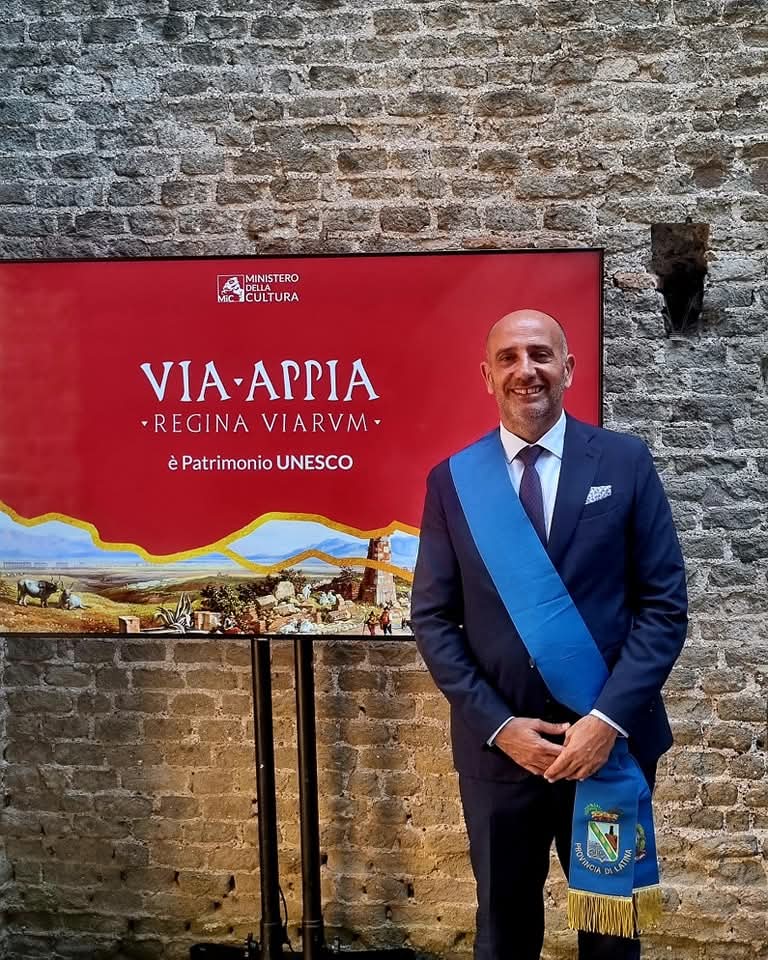

The initiative aims to promote and manage the sustainable tourism development of the Pontine section of the Appian Way, now a UNESCO World Heritage Site, stretching from the Pontine Plain to the Garigliano River, south of Rome.
The Province of Latina played a leading role in securing UNESCO recognition, coordinating 13 municipalities along the Appian Way. Through a memorandum of understanding, these municipalities gathered documentation, launched initiatives, and established a governance model that remains active today. This collaborative framework has since been recognized by Italy’s Ministry of Culture as a model for managing cultural heritage across regions.

The Appian Way covers four regions, ten provinces, three metropolitan cities, and 74 municipalities, as well as numerous parks and institutions. The challenge now is to balance heritage preservation with economic and cultural enhancement. According to Stefanelli, the Province of Latina “has carved out a leading role” by demonstrating effective coordination and vision.
The project envisions the Latina stretch of the Appian Way as a meeting point between history, culture, tourism, and local flavors. The route has been divided into thematic itineraries—historical, cultural, cycling, and food and wine—connecting the municipalities of Cisterna, Latina, Norma, Sermoneta, Sezze, Pontinia, Terracina, Fondi, Itri, Formia, Gaeta, Monte San Biagio, and Minturno.
A comprehensive media plan supports the initiative, featuring a dedicated website, social media presence, interactive maps, and promotional videos. The Appia Regina Viarum – Provincia di Latina brand was launched in September with a concert at the Roman Theater of Minturnae, accompanied by a soundtrack donated by American composer Ron Jones.
The Province’s participation in the Paestum event will spotlight three key themes:
- Archaeology
- Food and Wine
- Cycling Tourism
Tourists currently visiting the Pontine stretch mainly come from Northern Europe and French-speaking regions, including Canada. The goal is to develop a high-quality, integrated tourism system that celebrates both the Appian Way’s historical legacy and the living traditions of the territory.
“This is only the beginning,” Stefanelli remarks. “The Province of Latina and its section of the Appian Way will continue to play a leading role through 2026 and beyond. The Appian Way is more than an ancient Roman road—it is a symbol of connection, encounter, and shared journeys.”