


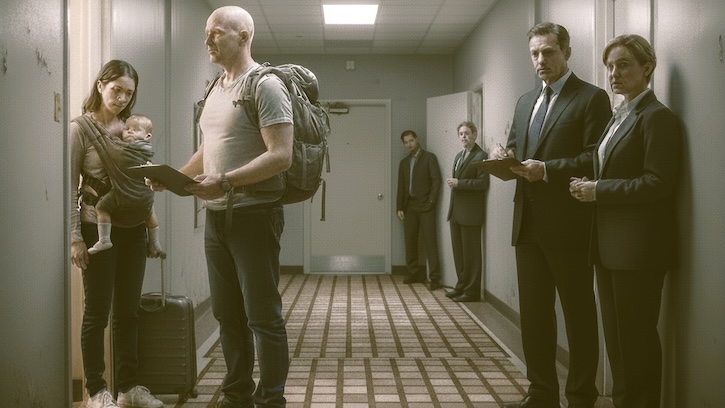

This morning, watching MSNow’s coverage of immigrants on the cusp of citizenship being rounded up by ICE agents, I gave silent thanks for being born in the United States. The camera showed not only fear, but disbelief—people clutching papers, families holding onto plastic bags with their few possessions, a toddler gripping an adult’s coat sleeve with white-knuckled terror. It was the kind of scene my father—born in the former Soviet Union—warned me about.
SOURCE: In My Personal Opinion
That gratitude extends to one of my parents… the one born in the former Soviet Union, who came to the USA so that he would no longer have to endure the daily humiliations of authoritarianism—cruelty that, tragically, resurfaces in new disguises within a nation that proclaims democracy its foundation. He taught me how authoritarianism doesn’t march in with boots; it creeps back in through small permissions, shrugged shoulders, averted eyes, and the casual abuse of petty power.
But gratitude demands awareness. It’s tempting to imagine inhumanity as distant, unfolding in other cities or on national news feeds. The truth is more unsettling: cruelty lives much closer, down the hall, across the courtyard, inside our workplace.
In My New York Co-Op
What happens inside one building mirrors where we’re headed as a people. You think you need a dictator to erode democracy? Often all it takes is a hallway where neighbors stop looking at one another, a board that stops listening, a culture that decides silence is easier than principle.
When Power Replaces Principle

Our board of directors behaves like proprietors of a private empire, not stewards of a shared community. Rights codified in our governing documents, meant to protect residents from bias and abuse, are ignored at will. Arrogance replaces accountability; pettiness displaces principle. These individuals don’t guide a collective home; they rule a private fiefdom. And let me be clear: this isn’t an abstract complaint. When a board refuses to answer emails, fabricates fines, stonewalls repairs, or selectively enforces rules, they are not merely “difficult.” They are participating in the earliest stages of civic decay.
History shows us that authoritarian behavior is rarely born at the top; it is cultivated in small rooms by people who discover that no one will stop them. It’s difficult to call them adults when they fail the basic requirements of maturity: respect, empathy, integrity, the capacity to live among others without asserting dominance.
So how do we identify an adult? By their actions when fairness costs them something. By their willingness to coexist without cruelty. By their refusal to dominate the vulnerable. And, I would add, by their willingness to say, “I was wrong,” a sentence that authoritarian personalities cannot bear to speak.
They Aren’t Coerced into Inhumanity—They Choose It Ordinary Cruelty, Extraordinary Consequences
On LinkedIn, I read daily about loyal employees, five, ten, thirty years of service, fired without warning. No farewell. No gratitude. No explanation. Some learned their fate through an automated email weeks before the holidays. Others discovered their termination when their access badges stopped working or their computer logins went dead. I recently read about an employee who found out they’d been replaced only because their payroll deposit failed to appear. These aren’t corporate inevitabilities; they’re decisions. Calculated acts performed by people who could have handled the situation with dignity—yet chose not to.
The cruelty ordinary people wield in positions modest and powerful defies easy description. And much of it is voluntary. No one forces them to harm others. They choose it: for convenience, for control, for pride, for the fleeting satisfaction of asserting power. This isn’t a lack of rules; it’s a drought of conscience. We imagine evil as grand and orchestrated. More often, it’s quiet and local. The neighbor who stays silent. The manager who disables an employee’s login before day’s end. The co-op board that forgets its role is to serve, not rule. The supervisor who schedules someone for a shift they know the person cannot physically work, just to “prove a point.”
Here is the truth we resist: when ordinary people discover they can get away with cruelty, they test the boundaries. And when no one pushes back, they expand those boundaries. That is how cultures collapse—not with explosions, but with permissions.
Civilization Begins Small
If civil society exists, its foundation is built at the smallest scale. Civilization is constructed or dismantled through daily acts of conscience. When we allow micro-cruelties to pass unchallenged, we normalize them. They evolve from exception to pattern, from pattern to culture. Once culture corrodes, restoration becomes exponentially harder. Every atrocity in history began with people saying nothing when something small went wrong. A snub. A lie. A violation brushed aside. A person mistreated because “it wasn’t my business.” A rule bent because “it wasn’t worth the fight.”
So today, I’m asking readers not just to feel outrage, but to intervene. Speak when silence is simpler. Stand with a colleague treated unfairly. Question those who sit comfortably in positions of unearned authority. Offer kindness to someone who expects indifference. Every act of humanity, every refusal to participate in cruelty, restores a thread to our shared social fabric. Those threads, infinitely small and profoundly strong, hold civil society together. Fairness is not an institution; it is a practice.
Civility is not legislation; it is a discipline. Humanity is not inherited; it is a decision renewed moment by moment. And make no mistake: the moment will come. It comes for all of us—the moment when we must decide whether to be complicit or courageous. When the world grows cold and neighbor turns against neighbor, those who choose empathy become the final guardians of what it means to be human. If cruelty is within your reach, kindness is too. One choice pulls civilization apart; the other stitches it back together. The question, perhaps the only question, is this: What will you choose when it is your moment?