


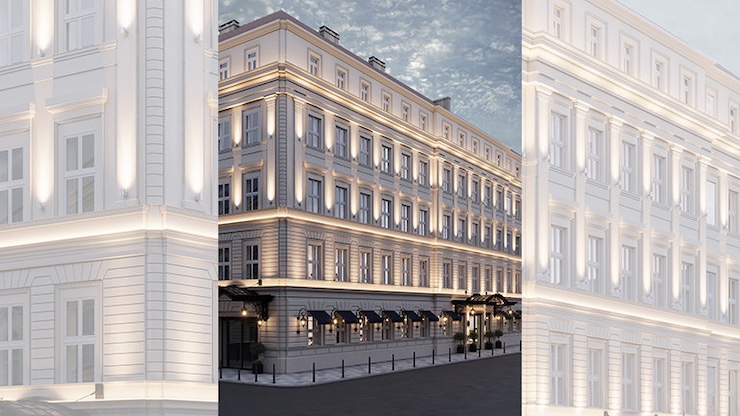

InterContinental Hotels & Resorts (IHG) is set to return to Prague after a year-long absence, following an agreement between its parent company, IHG Hotels & Resorts, and Generali Real Estate to convert a 19th-century building in the city’s Old Town into a 137-room luxury hotel.
The property, located on Jeruzalémská Street near Prague’s main railway station, is expected to open in the first half of 2029 after an extensive renovation. The building, which dates to 1839, has served as a dance hall, theater and most recently an office complex. Generali Real Estate, which manages a portfolio of hotel and commercial properties across Europe, will oversee the redevelopment.
The opening will mark InterContinental’s re-entry into the Czech market, where the brand previously operated a flagship on the banks of the Vltava River before it was sold and rebranded by new ownership in 2021. IHG currently operates two midscale hotels in Prague under its Holiday Inn brand.
“This milestone represents a key moment in our Central and Eastern European development strategy,” Willemijn Geels, IHG’s vice president for development in Europe, said in a statement. She added that the company aims to strengthen its luxury and lifestyle presence across the region as travel demand rebounds.
The planned hotel will include a spa, indoor pool, restaurant, bar and the company’s Club InterContinental lounge. It will also feature a private garden, an uncommon amenity in Prague’s historic core, and conference facilities aimed at business travelers.
Prague, one of Europe’s most visited cities, has experienced strong tourism recovery following the pandemic, with hotel occupancy and room rates surpassing 2019 levels, according to industry analysts. International hotel groups have been increasing their investments in the region in response.
“For us, this represents the opportunity to restore one of the city’s heritage buildings and give it new life,” Ramon Spoladore, who leads Central and Eastern Europe and Nordic operations for Generali Real Estate, said.
IHG’s Growing Competition in Europe’s Luxury Market
The move comes as the world’s major hotel companies compete for a bigger share of Europe’s high-end travel market — particularly in historic city centers, where redevelopment opportunities are limited.
IHG, which recently began a broad repositioning of its InterContinental brand, operates 34 InterContinental hotels in Europe and says it has 67 luxury and lifestyle properties in its regional development pipeline. The company has been leaning heavily into historic buildings, a strategy shared by its competitors.
Marriott International, the world’s largest hotel company, has aggressively expanded its stable of luxury and lifestyle brands — including Ritz-Carlton, St. Regis, Edition and the Luxury Collection — with a particular focus on conversions of older European properties under its Autograph Collection and Tribute Portfolio labels.
Hilton, which has a smaller luxury footprint, has relied on its Curio Collection and Tapestry Collection for much of its European growth, while continuing to add select Waldorf Astoria and Conrad hotels in major cities.
Hyatt, whose portfolio is the most concentrated in the luxury and lifestyle segment, has been expanding its Thompson and Unbound Collection brands in Europe following its acquisition of Apple Leisure Group, which strengthened its presence in Mediterranean resort destinations.
Accor, the largest hotel operator in Europe, has broadened its luxury offerings through brands such as Raffles, Fairmont, Sofitel and the recently revived Orient Express name. Its Ennismore lifestyle division — home to Mondrian, SLS and Hoxton — has made the company a strong competitor in design-focused markets.
IHG’s planned Prague hotel adds to several high-profile projects across the continent, including upcoming InterContinental openings in Manchester, Belgrade and Cascais. The company also recently expanded its ultra-luxury Six Senses and Regent brands in Europe, intensifying competition with Marriott, Hyatt and Accor in the segment.
A Heritage-Focused Revival
Historic conversion projects have increasingly become a defining feature of Europe’s luxury hotel growth, as tourism operators seek properties with cultural significance and urban locations that cannot be replicated. Industry analysts say both financial and branding considerations drive the trend: conversions are often faster to bring to market than new builds, and they appeal to travelers seeking distinctive experiences.
The redevelopment of the Prague building — more than 180 years old — reflects this shift.
By the time the new InterContinental Prague opens in 2029, travelers could have a broader range of luxury options across Central and Eastern Europe, as global hotel groups continue their expansion in cities once overlooked for major international brands.