


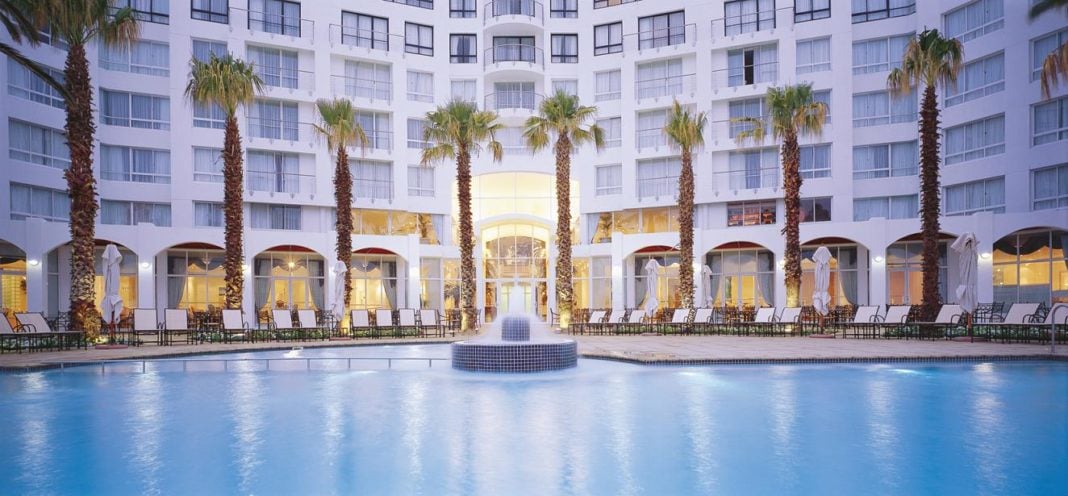

Hilton has accelerated its Africa expansion with new DoubleTree by Hilton signings in Morocco, Togo, and the Republic of Congo, highlighting intensifying competition among global hotel groups for strategic African markets and pushing Hilton’s continental development pipeline beyond 100 hotels.
The latest agreements span North, West, and Central Africa, reflecting a deliberate growth strategy focused on airport locations, capital-city corridors, and proven leisure destinations. Among the most significant is DoubleTree by Hilton Lomé Airport, a 165-room hotel developed in partnership with Sodexh SA, which will mark Hilton’s debut in Togo and become the country’s first internationally branded airport hotel.
Airport hotels are increasingly viewed by international investors as lower-risk assets in emerging markets, benefiting from a mix of business travel, airline crews, meetings traffic, and government-related demand, often delivering more resilient occupancy and average daily rates than purely leisure-focused properties.
In Central Africa, Hilton is partnering with Société d’Exploitation et de Développement des Infrastructures du Congo (SEDIC) on the DoubleTree by Hilton Kintele, scheduled to open in 2026. The property will complement the recently opened Hilton Brazzaville Les Tours Jumelles Hotel & Residences, strengthening Hilton’s position in Brazzaville as a hub for government, conference, and institutional travel.
Hilton is also expanding further in Morocco, one of Africa’s most competitive and resilient hospitality markets, with the signing of the 228-room DoubleTree by Hilton Marrakech La Palmeraie, expected to open in 2028. The project brings Hilton’s Morocco pipeline to 16 hotels, underscoring sustained confidence in the country’s leisure demand, air connectivity, and investor-friendly development environment.
The new properties will join DoubleTree by Hilton’s global portfolio of more than 700 hotels across 61 countries and territories. They also build on earlier Africa signings announced this year, including DoubleTree by Hilton Cabinda Futila Residences in Angola, DoubleTree by Hilton Adama and Dire Dawa in Ethiopia, and DoubleTree by Hilton Fes Golf in Morocco.
Togo: an under-the-radar West African growth play
Hilton’s entry into Togo stands out as a strategic first-mover move into one of West Africa’s least penetrated internationally branded hotel markets. While Lomé is not yet a mass tourism destination, it has quietly strengthened its role as a regional aviation, logistics, and diplomatic hub, supported by Lomé–Tokoin International Airport, a major deep-water port, and relative political stability.
Demand in Togo is driven primarily by business travelers, regional organizations, NGOs, aviation crews, and government-related traffic, rather than leisure tourism. This makes an internationally branded airport hotel particularly well aligned with market fundamentals. For global hotel groups, Togo represents an opportunity to establish brand standards early, capture long-term institutional demand, and benefit from gradual growth as infrastructure investment and regional trade expand.
West Africa comparison: Togo vs. Ghana, Benin, and Côte d’Ivoire
Compared with neighboring Ghana, Côte d’Ivoire, and Benin, Togo offers a distinctly different risk-reward profile. Ghana, particularly Accra, is already a mature and competitive branded hotel market, with strong presence from Marriott, Accor, Kempinski, and others, driving higher land costs and intense competition. Côte d’Ivoire, led by Abidjan, has emerged as Francophone West Africa’s commercial capital, attracting large-scale international investment but also requiring higher capital commitments and longer development timelines.
Benin, like Togo, is still an emerging market, but its hospitality development remains more limited and less aviation-driven. Lomé’s airport connectivity and port infrastructure give Togo a comparative advantage for transit, meetings, and regional business travel, positioning it as a niche but potentially resilient hospitality market. For brands such as Hilton, Togo offers a lower-saturation alternative to Accra or Abidjan, where early entry can translate into long-term market leadership.
Africa’s hotel development race intensifies
Hilton’s latest signings come amid one of Africa’s strongest hotel development cycles in years, with more than 570 branded hotels and over 100,000 rooms in the continent-wide pipeline. North Africa continues to lead in volume, while Sub-Saharan Africa is seeing more selective investment in airports, capital cities, and secondary hubs with improving connectivity.
Rival groups are moving quickly. Marriott International holds the continent’s largest pipeline, Accor continues to expand through master development agreements and conversions, IHG is targeting high-impact openings in North and Southern Africa, and Radisson Hotel Group is pushing conversion-led growth in secondary cities.
Why DoubleTree fits Africa’s current cycle
Hilton’s reliance on the DoubleTree by Hilton brand reflects a broader industry shift toward mid-to-upscale hotels that balance brand recognition, operational flexibility, and owner returns. Locations such as Lomé Airport, Kintele near Brazzaville, and Marrakech’s leisure corridors align with where demand has proven most durable.
As global hotel groups continue to stack pipelines across Africa, Hilton’s expansion highlights a clear trend: growth is becoming more strategic and location-driven, with success increasingly defined by first-mover advantage, infrastructure alignment, and long-term fundamentals, rather than sheer hotel count alone.