


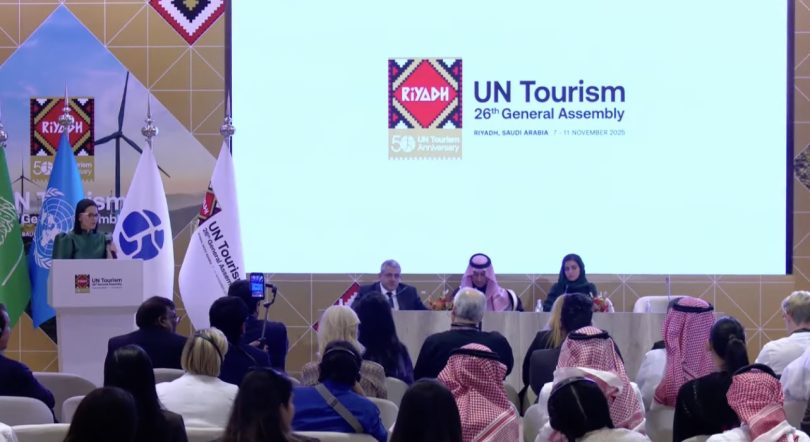

Coinciding with the organization’s 50th anniversary, the event marked the end of Zurab Pololikashvili’s tenure and the historic appointment of Shaikha Al Nowais as the first woman to lead UN Tourism.
Described by one delegate as a “love fest,” the week-long event was hosted by His Excellency Ahmed Al Khateeb, Saudi Arabia’s Minister of Tourism, and drew record participation — with more than 150 delegations, 90 ministers, 70 ambassadors, and over 120 private-sector representatives attending.
A New Global Roadmap: The Riyadh Declaration
A centerpiece of the Assembly was the unveiling of the Riyadh Declaration on the Future of Tourism, which outlines a shared global vision for the sector. The declaration emphasizes that tourism is “at a turning point in how people travel, how destinations evolve, and how communities thrive.”
Countries worldwide pledged to advance a more sustainable tourism sector, embracing digital transformation and addressing workforce challenges.
The document outlines 11 commitments, starting with a call for all UN Tourism member states to “act immediately to advance and accelerate progress towards a more sustainable tourism sector that balances environmental stewardship, economic vitality, and social well-being.”
Among its goals, the declaration urges governments to:
- Promote responsible adoption of digital transformation by investing in digital infrastructure and innovation.
- Strengthen resilience through risk assessment, adaptive infrastructure, and rapid-response mechanisms.
- Address workforce shortages and skills gaps by expanding tourism education and cross-border knowledge sharing.
- Preserve culture and social fabric, ensuring that growth is respectful, inclusive, and community-driven.
The declaration acknowledges that technologies such as artificial intelligence are reshaping the travel industry, and calls for the responsible and equitable adoption of digital tools across the sector.
At the press conference announcing the declaration, UN Tourism Executive Director Natalia Bayona said:
“This is the biggest General Assembly in the history of the organization. We are setting a clear vision for the future — with tourism as a driver of peace, prosperity, innovation, and sustainability for all.”
The declaration also directs Secretary-General Shaikha Al Nowais to present a strategic roadmap on the future of tourism within a year, including an AI Impact on Tourism Report and Recommendation Guide. A Global AI Readiness Index for tourism will help countries measure and improve their preparedness for digital transformation. The report’s findings are expected to be presented at the 2027 Executive Council session.
Saudi Minister of Tourism Ahmed Al Khateeb described the Riyadh Declaration as “a roadmap for collaboration and resilience,” adding that “all decisions were taken in a positive atmosphere, underscoring the Kingdom’s coordination abilities.”
Leadership Transition and New Hope
The Assembly marked a symbolic shift in UN Tourism’s direction. Shaikha Al Nowais will officially assume office in January 2026, succeeding Zurab Pololikashvili after his eight-year tenure.
Al Nowais, who previously addressed the WTTC Summit and Global Tourism Summit in Brussels, has pledged to strengthen transparency and continuity while championing sustainability, inclusion, and innovation.
She confirmed her commitment to expanding the Best Tourism Villages initiative, a hallmark of Zurab’s administration, and emphasized collaboration as key to ensuring tourism remains “a force for good” worldwide.
Controversies and Exclusions
Despite the event’s optimism, some controversies lingered. The press conference notably excluded certain media outlets, including eTurboNews (eTN) — a veteran publication that has covered UNWTO for 25 years. eTN was reportedly banned during Zurab’s administration after supporting Dr. Walter Mzembi’s 2017 leadership bid.
Adding to the tension, former Secretary-General Francesco Frangialli, who led UNWTO for 12 of its 50 years, was denied entry at the venue despite being invited by the Saudi hosts to attend the anniversary celebrations.
Saudi Arabia’s Expanding Role
The Riyadh Assembly further solidified Saudi Arabia’s role as a global tourism powerhouse. Under the leadership of HE Ahmed Al Khateeb, the Kingdom has become a center for tourism diplomacy and innovation, known for stepping up during global crises, such as the COVID-19 pandemic.
“When the world didn’t know where to turn during COVID, Riyadh answered the call,” one minister told eTN. “Saudi Arabia has proven itself as both a convener and a problem-solver.”
The Dominican Republic was officially selected to host the next General Assembly in 2029, marking a symbolic handover and celebration of continuity in leadership.
Education and Global Collaboration
On the sidelines of the Assembly, Saudi Arabia and Austria launched a new Tourism Hub at King Saud University, in collaboration with IMC Krems University of Applied Sciences.
Austrian State Secretary for Tourism Elisabeth Zehetner highlighted that the initiative will foster joint education programs, data-driven research, and sustainable tourism development.
“We are learning a lot from Saudi Arabia,” Zehetner told Arab News. “Your approach to sustainability, diversification, and education offers important lessons for all of us.”
Zehetner also emphasized the transformative role of AI in tourism, noting that Austria is experimenting with AI-driven hotel management, virtual tours, and automated concierge systems to alleviate workforce shortages.
Looking Ahead for UNWTO
As the General Assembly concluded, Riyadh prepared to host another major milestone — the first TOURISE Conference, which will bring together policymakers, innovators, and investors to shape the next phase of global tourism development.
Though eTurboNews was not allowed to participate, the UNWTO presence of both the outgoing and incoming secretaries-general at the final press conference was seen as a hopeful sign of renewed transparency and inclusivity under Shaikha Al Nowais’s leadership.
eTN is accredited for the upcoming TOURISE Conference in Riyadh.
Founded in 1975, the UN World Tourism Organization (UN Tourism) is the United Nations agency responsible for promoting responsible, sustainable, and universally accessible tourism. Over five decades, it has guided policy, innovation, and collaboration across the global tourism ecosystem — now entering a new era of digital transformation and inclusivity.