


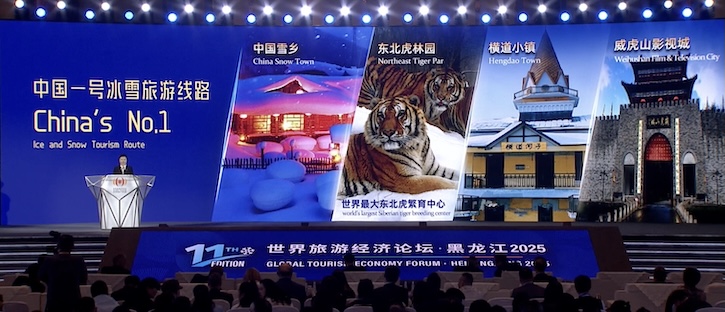

China’s expanding visa-free and transit travel policies are not only boosting inbound tourism but also accelerating a broader shift in the global Travel & Tourism landscape, according to discussions at the Global Tourism Economy Forum (GTEF) held in Harbin.
Welcoming the Chinese government’s ongoing facilitation measures, the World Travel & Tourism Council (WTTC) highlighted how simplified entry policies, combined with large-scale infrastructure investment, are strengthening China’s position as a future global tourism leader.
Speaking during a keynote on Global Trends and China Outlook, WTTC Interim President & CEO Gloria Guevara said China’s appeal lies in its diversity and readiness for scale.
“Travelers come for the heritage, the energy of the cities, the landscapes, and the caliber of the country’s infrastructure,” she said. “China offers a breadth of experiences that appeals to visitors from all over the world.”

China’s Rapid Ascent in a Competitive Global Market
WTTC estimates that in 2025, China’s Travel & Tourism sector will contribute $1.9 trillion to the national economy, growing at 15.8% annually—twice the global average. Inbound visitor spending is projected to reach $144.1 billion, while domestic tourism spending is expected to approach $968 billion.
The sector is forecast to support 83.4 million jobs in 2025, rising to 103 million by 2035, with one in five new global Travel & Tourism jobs expected to be created in China over the next decade.
Visa-free policies are emerging as a decisive advantage. WTTC projects that inbound visits from newly visa-exempt countries will reach 15 million by the end of 2026, with these visitors spending around $1,000 more per trip than the average international traveler.
Looking ahead, China’s Travel & Tourism sector is forecast to grow 7% annually, reaching a $3.8 trillion GDP contribution by 2035, equivalent to nearly 14% of the national economy. By 2031, China is expected to overtake the United States as the world’s largest Travel & Tourism market.
Global Comparison: China, the U.S., the EU, and ASEAN
The forum placed China’s growth within a broader global context, highlighting a clear divergence in market maturity and growth trajectories.
The United States remains the world’s largest tourism economy, driven by a powerful domestic travel market and an estimated $2.6 trillion contribution to GDP. However, growth is moderating as international arrivals recover more slowly and costs rise.
The European Union, collectively the world’s most visited region, continues to benefit from strong intra-European travel and high per-visitor value. Travel & Tourism is projected to contribute around €1.9 trillion to the EU economy in 2025, supporting approximately 26 million jobs, though growth remains steady rather than rapid.
Meanwhile, ASEAN has emerged as one of the fastest-growing tourism blocs, fueled by youthful demographics, cost competitiveness, and strong intra-regional travel. Countries such as Thailand and Vietnam are seeing record arrivals, positioning Southeast Asia as a key growth engine for global tourism demand.
Against this backdrop, WTTC views China as the market with the strongest long-term momentum, combining scale, policy support, infrastructure readiness, and rising inbound demand.
GTEF: A Global Platform Beyond China
Now in its 11th edition, GTEF brought together over 1,000 delegates from more than 30 countries, including government leaders, tourism ministers, international organizations, Fortune Global 500 executives, and global investors. The forum was held outside Macao for the first time, underscoring its growing international scope.
Key themes included:
- Cross-border tourism cooperation and connectivity
- Investment-led destination development
- Cultural empowerment and destination branding
- Innovation in climate, winter, and experiential tourism
The forum also highlighted Harbin’s transformation into a flagship winter tourism destination. Last winter, the city welcomed 90 million visitors, generating nearly $19 billion in tourism spending, a 17% year-on-year increase, positioning it as a case study in destination reinvention.
“Places like Harbin show how natural strengths can be developed into world-class visitor experiences,” Guevara said.
Strengthening Global Collaboration
During the forum, WTTC signed a Memorandum of Understanding with GTEF, aimed at strengthening collaboration, facilitating global partnerships, and supporting sustainable, long-term tourism growth across China and beyond.
As global Travel & Tourism continues to rebound and rebalance, discussions in Harbin underscored a key message: while the U.S. and Europe remain foundational pillars of the global tourism economy, the next phase of growth is increasingly shifting toward Asia—led by China and ASEAN.