




More than 60% of the respondents to a survey by ITB Berlin fear “political and economic conditions” will have a bigger impact on business than either technology or climate change. The response has paved the way for a long-overdue shift in the focus of discussion at the world’s biggest travel show, as well as other travel forums.
On 22 July, Messe Berlin, organizers of ITB Berlin, released the findings of the first part of an inaugural Travel & Tourism Radar survey, designed to shape the content of the 2025 ITB Convention to be held between 4-6 March under the theme “The Power of Transition Lives Here.” The Ostfalia University of Applied Sciences conducted the 18-question Survey online between May-June 2024 on the topic of “Business Climate & Sustainability”. It had a sample size of 414 and received 332 fully completed responses.
In a press release, Deborah Rothe, Director of ITB Berlin was quoted as saying, “During Covid, debate in our industry often focused on the long-term need to become crisis-proof. The present study shows that sustainability efforts are often driven more by necessity than by economic motivation – for us, a signal to address and explore this theme in the upcoming edition of ITB Berlin.”
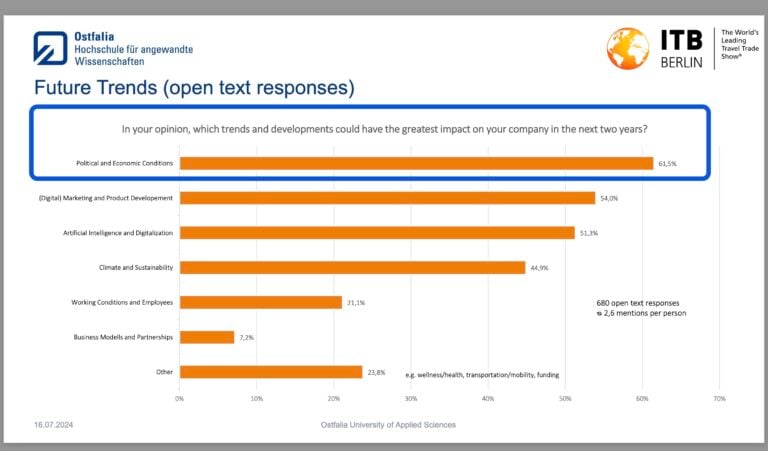
As most of the questions were related to digitization and sustainability, the responses were in line with that. However, when asked “Which trends and developments could have the greatest impact on your company in the next two years?”, a significant majority (61.5%) identified “Political and Economic Conditions”.
That was well ahead of both technology and climate sustainability (see image below).
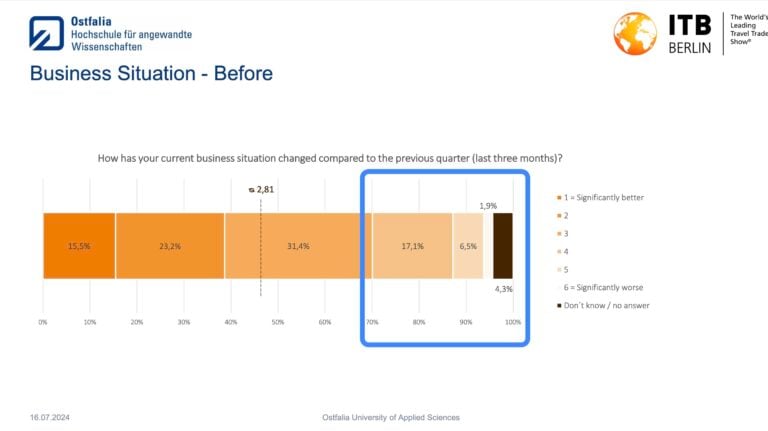
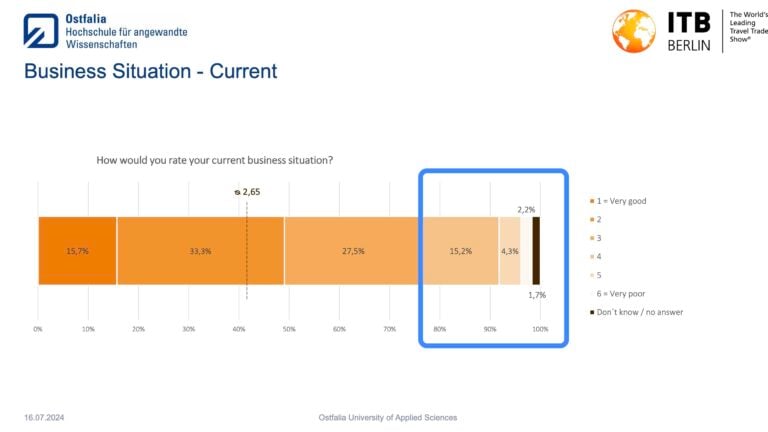
The press release otherwise sought to paint an upbeat picture, noting that respondents were generally positive about their situation in the 2024 second quarter, as against the first quarter. It said, “The outlook for the immediate future also appears good. Accordingly, the companies polled were optimistic about developments in the next quarter. The survey’s organizers noted stable investment plans and identified the direction that future investments might take.”
However, the 61.5% level of concern about the future impact of adverse political and economic conditions cannot be swept under the carpet. Such conditions can be just as destabilizing as health pandemics and natural disasters. While earthquakes and tsunamis cannot be predicted, political and economic crises can be both predicted and, in some cases, prevented.
The onus is now on ITB Berlin to respond to its own findings.
Indeed, a closer look at the survey results shows that many respondents are hurting now, even though they may be in the minority (see below). It would be fair to assume that most of these would be small and medium sized companies. In which case, the industry is duty-bound to ask what kind of help they need.
Indeed, the history of the ITB Berlin can prove the importance of political and economic conditions as influencing factors.
It was born in 1966 in the midst of an era of direct political confrontation between the then communist Iron Curtain countries and the democratic Western countries. Although it grew steadily, defying the odds even then, it took off when political and economic conditions improved after the end of the Cold war and the reunification of Germany.
Thereafter, attendance has fluctuated in direct relation to political and economic conditions, especially for specific regions and countries. A detailed analysis of the ITB attendance by country, not just by the overall total, will prove that.
Today, the Russia-Ukraine and Palestine-Israel conflicts are clearly impacting travel. How much better would the industry be faring overall if these conflicts were not raging?
Global shows with the prestige and status of ITB Berlin need to provide a platform and a voice to discuss the concerns of the industry at large, especially those who get most hurt by these adverse conditions.
There is plenty of opportunity to probe further. The findings released on July 22 are only the first of a three-part survey. The press release said the second part will be conducted in mid-October and the third at the “turn of the year.” It said the findings of all three surveys will be incorporated into planning the program of the ITB Berlin Convention 2025.
“The aim is to examine how the industry can in future view digitalization and sustainability efforts as being more than a requirement dictated by legislation and customer needs,” it said.
The high level of concern about the impact of “political and economic conditions” needs to be added to that list, especially if the ITB Berlin truly wishes to make the industry more “crisis-proof”.
You may also like

UAE, Qatar, Israel: When “Rescue Flights” Become PR Campaigns: How Private Jet Charters Profit From Crisis Travel

New Routes, New Recognition, New Rhythm: What’s Next for The Bahamas This March

Angola Steps Into the Spotlight as ITB Berlin Marks 60 Years Amid Global Uncertainty

ITB Berlin 2026 Opens with Space to Breathe — and a Powerful Reminder That Tourism Resilience Endures
About the author

Imtiaz Muqbil
Imtiaz Muqbil,
Executive Editor
Travel Impact Newswire
Bangkok-based journalist covering the travel and tourism industry since 1981. Currently editor and publisher of Travel Impact Newswire, arguably the only travel publication providing alternative perspectives and challenging conventional wisdom. I have visited every country in the Asia Pacific except North Korea and Afghanistan. Travel and Tourism is an intrinsic part of the history of this great continent but the people of Asia are a long way away from realizing the importance and value of their rich cultural and natural heritage.
As one of the longest-serving travel trade journalists in Asia, I have seen the industry go through many crises, from natural disasters to geopolitical upheavals and economic collapse. My goal is to get the industry to learn from history and its past mistakes. Really sickening to see the so-called “visionaries, futurists and thought-leaders” stick to the same old myopic solutions which do nothing to address the root causes of crises.
Imtiaz Muqbil
Executive Editor
Travel Impact Newswire